Thursday, April 25, 2019

She'll get used to it ...

Have you ever had a dog that was a bit scared of something and  you thought perhaps if she just "gets used to it" she'll figure out it's ok? I see a lot of the mindset that if a dog is scared (or just unsure) of something that all they need is more exposure to that something in order to "get used to it". Unfortunately it doesn't work like that.

Let me use the example of a dog not too keen on riding in the car. Maybe it's not even crippling fear but just a bit of stress in the car. So, you think, I'll just take her in the car more so she'll get used to it. That will get my dog to understand that the car isn't so bad, right? I mean nothing bad happens in the car. So she'll just get used to it if I take her in the car all the time, right? Well, actually this won't get her used to the car.

Here is the thing with stress and/or fear –– it doesn't just go away on its own or over time by forcing the dog to be in the situations and/or around the things that scare them or make them nervous. There is actually a term in psychology for this "technique"–– it's called flooding. You will find some dog trainers that use flooding as a training tool, and they will swear that "it works". Here is why some dogs appear to be getting past their fear or stress –– flooding causes dogs to shut down or present what is called "learned helplessness". This means the dog realizes it has no other choice but to just sit through the situation as it cannot escape so it just does nothing. However, while doing nothing they are mentally panicking, some a lot some just enough to make it uncomfortable. Either way, they are not coping, and they are definitely not "getting used to it". They are praying for the moment they can get away or go back to a place that's safe for them. They are also not moving past their previous viewpoint on the very thing you were attempting to get them "used to".

Let me try to put this in perspective. Let's say you are afraid of spiders and I put you in a room full of spiders. The spiders are in a huge enclosed tank, at the other end of the room. They cannot get to you. But you cannot leave. You have to sit there for an hour and try to just "see" that it's not so bad, I mean after all they are in a tank and across the room ––right?! However, likely you will begin to try coping mechanisms. This is a physiological response that the body does. This is whether you are a human or an animal. You go into survival mode. You'll probably be staring intently at that tank full of spiders. You probably will start talking to yourself, trying to calm yourself –– "see, they can't get to you, see they aren't so bad." You may start breathing techniques. You will probably talk to yourself some more. You will probably look over at the tank every 2 seconds. You will probably start to possibly think of worst case scenarios. What if they get out? What if the lid isn't on tight enough? What if someone forgets about you? . . . You will be hyper-focused on the spiders. You will be counting down until you can get the heck out of there. But what you won't do is walk out of the room and say "well that was great, now I'm not afraid of spiders! Thanks for that awesome session of flooding!"


I recall, probably 10 years ago, I was teaching a group class and a client in the class asked about how to help her dog "get used to people" because she's shy and timid around new people. One client that was in the class thought she'd give her two cents and she stated, "we just took ours on the Katy Trail all the time and she finally got used to people." For those not local, the Katy Trail is a very, very, very busy jogging and walking path that goes around a busy part of the huge city of Dallas. It has joggers, bikers, roller bladers, skaters, strollers and tons of dogs! It's seriously packed with people and dogs. It's too much for most dogs let alone a dog afraid of people! What likely happened to the client's dog that says "she finally got used to people" was that she continued to take her dog on the trail and the dog just tolerated it because it had no other choice. When a dog is in a state of learned helplessness they look compliant because they do nothing. It could appear to the untrained eye to be "obedient" (ugh I hate that word!) It looks like blind obedience but it's just a dog choosing to do nothing because it has zero options. This would apply here because on the trail all dogs are on a leash. A dog on a leash that's forced into a situation where it's not comfortable isn't going to do much of anything as it has no choices.

On another side of that some people could argue, "so what's wrong with the dog just getting by and doing nothing?" Why is this "learned helplessness" so bad? Sounds like they don't do anything bad so, meh. Why not?!  But here is the thing, mentally your dog isn't ok. They haven't learned to be ok, they've learned that they have no choice. I don't know about you but I like to have a dog that is actually ok with the thing or situation that makes them nervous, uneasy or anxious. I don't want to just put a band-aid on my wound if it's never going heal. Why can't I do something to make the wound disappear completely?!

So how does one know if a dog is exhibiting learned helplessness, being shut down, or truly "used to" something? Great question! A dog that is not truly ok in a situation will show signs of stress. Now, the kicker here is that you gotta be a real Dog Decoder (by they way that's actually a dog body language app, go download that now, here!) with body language. This is where dogs will often show super subtle signs of stress so you'll need to be a great detective here. Things such as whale eye, licking their lips, tail tucked (or lowered heavily), head averted, eyes averted away, paw lift, eyes blinking, eyes squinting, panting out of context, heavy shedding, moist paw pads and even just sitting there staring and frozen (with a few of these others signals likely to be occuring at the same time.)

Now, remember reading stress signals takes you looking at the whole dog and really understanding what you're looking at.

Dogs that are "used to" or ok with something will show loose body, ears, eyes, mid-line tail wagging that's loose, often eliciting interactions and exploring things on their own without showing signs of fear or uncertainty. They will not just sit frozen. They will also listen to you when you ask for something most likely while the unsure dog –– or flooded dog –– will often seem to ignore you when you ask something of it.

Here is the thing with science and psychology –– you can train a dog to be comfortable with things and situations by choice. You can do it the right way. You can do it so that with the proper training your dog will actually like going on that car ride that previously made her nervous. You can teach your dog that previously thought men were scary that they aren't so bad, and actually could even be good! Your dog will make their own choices and even moreover –– your dog will be confident as a dog and mentally balanced. That's the dog I want! How about you?

If you have a dog with any kind of fear, anxiety, stress or phobia please contact a positive-based trainer that understands how to properly use classical, counter conditioning and desensitization to modify behavior. You also need to have any anxious dog visit a licensed veterinarian that is well educated in behavioral medicine before implementing a training plan. Some dogs do require medication to aide in the process. This is on a case by case basis but no one should brush off the power of medicine when owning a fearful and/or anxious dog.

Need help finding a qualified professional near you? Hit me up in the comments!


Stacy Greer, CPDT-KA
servicing Dallas/Ft Worth, Texas & surrounding cities

Tuesday, February 5, 2019

Mental Stimulation & Enrichment: What is it anyway & why?!

I know my clients hear me talk about this all the time. I also suggest it as a solution to many doggie behavior complaints — because it often is a solution, if not something that would help dramatically!

However, I don't see it utilized as much as it should be. Actually, I find it interesting how many people would rather take a one hour walk/run with their dog vs 15 minutes to prepare an enrichment toy or food puzzle for said dog.

I think the issue is that so many people have had it drilled into their heads that exercise is the answer to a dog's misbehavior, or that if they were exercised more their behavior would improve. This is rarely true. This is a whole other topic. I don't mean you shouldn't exercise your dog but it's not going to solve your dog's issues in the way that you likely have been told it will. (I wrote a blog post on this titled, "Stop Walking Your Dog" you may want to read for details on that.)

USE FOOD PUZZLES FOR MEALS NOT A TREAT
The #1 thing I hear from clients is this "Oh yeah I stuffed that thing [pointing to their dog's KONG] and he wasn't all that interested." I hear something along those lines as well as clients stating their dog wasn't even remotely interested in the KONG. Likely this is due to it not being used in the most beneficial way. Read on to learn more . . .

Most dogs know that their dog food will be provided in a bowl and they will have easy access to it, read: they can eat it easily and quickly out of the bowl. If you free-feed your dog (food is available at all times, not picked up and fed only at set times) this will be even more obvious because your free-fed dog often won't work for anything. They have food available at all times why would they do something that takes work to get food? On the other hand, if a dog has to work to get his meal he is going to do it or he knows that he won't be getting that meal!

So, I encourage dog owners to provide their dog's meal out of a food puzzle, not an extra thing full of treats the dog might [or might not!] enjoy. I recommend you feed your dog's entire ration of at least one meal per day out of a food puzzle so that she has to work to get it!

Food puzzles also can make feeding fun and some dogs become more encouraged to eat when given a fun way to do it. For dogs that eat too quickly food puzzles are a great way to force them to eat a bit slower as well as get some mental stimulation out of it.

If you want some examples of food puzzles and details on using them please download my handout here.

SO WHY DOES MY DOG NEED ENRICHMENT?
Enrichment doesn't just benefit hyper, over-aroused, active and busy dogs — it benefits all dogs! Dogs need enrichment because their brains need to work as much as, if not more than, their legs! Enrichment for dogs has been known to lower stress, encourage them to learn more efficiently, and increases problem solving skills which leads to a more emotionally balanced dog. In fact, mental enrichment is what will make your dog more relaxed and manageable, not 5 miles of jogging around the lake (unless you're allowing your dog to stop and sniff a lot during this run!)

Physical exercise is also important to your dogs, as it is to all living creatures (hey, humans too!). However, what most people don't realize is that dogs suffer more from lack of mental stimulation than they do from physical stimulation. Most people meet, if not exceed, their dog's physical stimulation needs but do not realize that this is not the need that needs to be met the most.
Dogs actually sleep anywhere from 16-20 hours a day, by nature (puppies and elderly dogs need more sleep than middle aged dogs). If your dog doesn't get enough sleep it's a lot like a child with not enough sleep — if you're a parent then you know what this looks like – it's not fun! As with children, dogs will usually show lack of sleep by acting out or showing behaviors that we definitely don't approve of. While a dog acting out doesn't always equate to a dog not getting enough sleep (it could be for a variety of reasons), I'm saying that a dog without enough sleep will definitely show some behaviors that are undesirable. Exercising to the point of exhaustion or not having your dog sleep enough will cause more problems than give the dog a reason to nap.

Dogs need to use their brains, legs and their comfy beds in order to be mentally and emotionally balanced –– and exhausted. More sleep actually makes for a calmer dog. So be sure your dog gets a very balanced day of sleep, exercise, enrichment and more sleep.

WHAT EXACTLY IS ENRICHMENT & MENTAL STIMULATION?
One standard definition of enrichment is: "Additions to an animal's environment with which the animal voluntarily interacts and, as a result, experiences improved physical and/or psychological health."

There are a lot of things that involve enrichment to fulfill your dog's mental stimulation needs everyday. They can range from somewhat simple to more complex. You should provide a variety of these to keep your dog's needs met. Don't always opt for the easy ones and don't always opt for the more challenging ones. If you stick to one or the other your dog may become frustrated due to boredom if too simple or due to not being able to solve the more difficult challenges. So be sure to stay on a sliding scale of difficulty.

Enrichment can be divided into six categories:
1. Sensory - This includes anything that stimulates your dog's senses. Sight, sound, taste, smell, and touch.

2. Feeding - By employing the power of your dog's nose and brain, you can encourage your dog to use their natural hunting and foraging skills at meal time.

3. Toys and Puzzles - These encourage your dog to manipulate them for a reward. The reward is usually food or treats, but could also include plush, rubber, rope, and fetch toys.

4. Environmental - Adding new things to your dog's life can sometimes increase their physical activity and make things more interesting. Try adding a mirror to a room in your house, build a ramp in the backyard, or go for a hike in a new place.

5. Social - Interaction with other people and other dogs builds self confidence and trust. Visiting the pet store, the dog park, or even a friend's house while practicing training and skills can help keep your dog well-rounded.

6. Training - Training can help strengthen the bond you have with your dog. It helps to build trust plus your dog will learn basic and important listening skills.

HERE IS A LIST OF GREAT ENRICHMENT IDEAS:
  • The dog's sniffer! I think that the absolute best type of mental enrichment is the type that involves your dog utilizing his nose to find food — I mean real sniffing and searching! I cannot stress how much this will wear your dog out. This type of enrichment far exceeds any type of physical exercise you could provide for your dog — by leaps and bounds.

    Allow your dog to forage, scavenge and find her food. You can do this by just simply 
    tossing your dog's ration of kibble out into a yard or field (when dog is on a long line) and let them sniff until they find it. If you live where you don't have a fenced in area to allow this (or don't want to go out to a field), then you can utilize a snuffle mat –– it's truly my favorite thing for this! Heck, use the snuffle mat everyday! Here is a snuffle mat (see pic & click to buy) in case you're thinking – what is a snuffle mat?

  • Fun with surfaces! Offer a variety of surfaces and textures for your dog to explore, train on and discover. This is especially beneficial to puppies from the time they start
    walking to the time they are around 14-18 weeks of age. This helps puppies not be afraid of different obstacles, surfaces and textures.

    However, any aged dog can benefit from this type of sensory input. Be wary of sharp rocks and other things and go slow if your dog isn't used to odd surfaces. Always use safety and precaution first and foremost! Use rewards. Scatter food on the surface for them to search and forage. Make this fun and rewarding. This is also a great confidence booster for dogs that may need an ego boost!

  • Sensory Gardens! You can make your own backyard tons of fun. There are loads of ides online for sensory gardens and fun for your yard to really make your dog have a fun and enriching space. Here is a great article on how to do your own sensory garden. Here is a guy who made his Huskies some great sensory and fun in his yard.

    These gardens can be anything from agility type equipment to mounds, tunnels, ponds or dog pools, decks and riverbeds to anything you can imagine! You can all kinds of things to make or buy at home garden centers and sometimes even just lying around your home or in your garage! You can have great fun with this one while also making your yard fun for your dogs ... and kids if you have those too!

  • Enrichment walks/hikes. Taking your dog out for walking is boring, if you really think about it. Most of the time people are making their dog walk in a straight line, no room for going anywhere to sniff or be a dog.  Make the walk truly beneficial –– let your dog sniff, a lot! As I stated above when discussing using their sniffer – when dogs are able to use their noses it's so incredibly rewarding as well as mentally stimulating for them.

    Let them use their noses on walks whether in nature (hiking, exploring), in your neighborhood (sniff mailboxes, lawns) or in the city (sidewalks, benches, etc.). Dogs need to sniff! I have my dogs on cue to let them know they can now go to the end of their leash so that we are still practicing leash manners. So you can do this too so that your leash manners still stay intact. I say "Ok you're free to go!" then they go to the end and sniff away!

  • Training. Obviously this one is my favorite because I'm best at this! However, many people leave out training. Even just simple foundation skills such as: hand targeting, sit, down, and come when called can benefit your dog in multiple ways. It is a great way to get your dog to use her brain while also learning basic skills that will be
    useful in more ways than one!  

    Training your dog really should be a must as it helps build the relationship between you and your dog as well as helps you get rid of any behavior issues that may be in play. Depending on your dog and any challenges you have this could be easy or complex. I do recommend you hire a professional trainer to help you in some way if you want to properly train your dog. 

The above are just a list of a few ways to give your dog mental stimulation and enrichment. You can be creative and have fun with it. Your dog will thank you for it! There are also a lot of fun DIY ideas on Pinterest that I've posted to my board. 

Remember to get a calm dog you want to provide all of the above and do not leave out the component of sleep – plenty of it too! If you give too much of one and not the other you'll likely see some behaviors that you don't like in your dog! When in doubt, always get in touch with a qualified, professional trainer in your area.


––––––––––
brought to you by
Stacy Greer, CPDT-KA
servicing Dallas/Ft Worth, Texas, USA
Copyright© 2019. All rights reserved.

Wednesday, October 10, 2018

Success Stations: What & how?

A what?! What in the world is a Success Station? A success station is a management tool. This means there is no actual training going on, but the dog is learning that good things happen in this particular place while other things are occurring in another part of the home. For example, pleasant things happen while they are in their crate while mom feeds the baby in the nursery.
 
SUCCESS STATION — any designated spot that a dog is limited to so that they have no option but to succeed. This spot must be introduced in a positive manner and is for limited periods of time only. (as defined by Family Paws Parent Education®)

FOR NEW PARENTS: NEWBORNS, INFANTS & TODDLERS APPLY
Family Paws Parent Educators primarily promote the use of these for parents with infants and small children, although there are many situations where a Success Station would be beneficial. (download handout pictured)

When a family has a new baby these stations are critical in helping mom and dad maintain some semblance of sanity. They create safe, enjoyable places for the family dog to stay when the regular routine is challenged because of the adaptations that come when accommodating a newborn’s needs. 

I personally do not like thrusting a huge training plan on to new parents. It's not fair and it's not realistic, and ... well ... it's not going to be followed. The truth is that new parents have too many other priorities than training the dog to respond to new behaviors. Success Stations are lifesavers for this very reason — they are simple and easy. When done properly, Success Stations get a dog in a safe place while he makes positive associations with what's going on with this new little attention-sucking human around. 

TYPES OF SUCCESS STATIONS: TETHER, CRATE OR GATE (OR X-PEN)
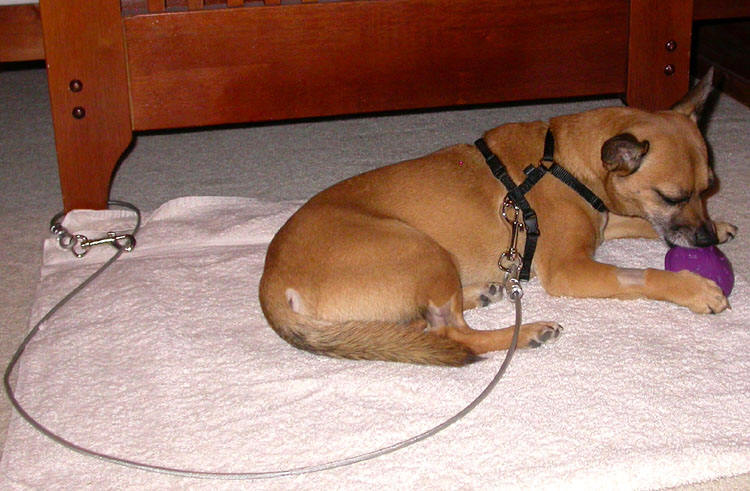
TETHER STATION
You can anchor a dog with a tether safely to an anchor (eye hook) in the wall (securely installed in a stud) or to a secure stationary object like a non-movable piece of furniture or do a reverse doorknob tether. A reverse doorknob tether (tm) — I totally just made that term up! — is when you put the leash on the opposite side of the door, on the knob, and shut the door on the leash so that it's completely secure. 

The tether is a great Success Station tool if you don't want your dog behind a physical barrier or out of the room (or he isn't good in those situations), but still safely secured so as not to be able to get up, move around and/or get to the baby. (Note: This is best when used only with non-mobile babies! Moving babies could easily approach a dog tethered and that's not safe, so other Success Stations are recommended for mobile babies, toddlers and kids.)  

CRATE STATION
My personal favorite Success Station is the crate. This is a great tool because it's totally secure and dog is completely out of the way and totally enclosed in a safe spot. This is also great for dogs that may be in the stage where they are still really unsure about the baby and you aren't certain of her feelings about this new little person, so they may feel better being in an entirely different room alone in a crate.

A crate Success Station is also perfect to use when you are very confident in how your dog handles being crated while you're home. If your dog is really crate-savvy and comfortable, this option is fantastic. If she's not, look at my troubleshooting section below.

GATE STATION (OR X-PEN)
Gates (or x-pens) are a great option as they help set boundaries for both dogs and children. They can also be located in various locations in your home and you can section off space that is large enough that Fido is comfortable and can have a nice space of his own away from baby. 

Be sure to get a secure gate and one that is tall enough for your dog. Also, be sure you know whether or not your dog will jump a gate or knock one over. If she does jump gates or knock them over I suggest maybe utilizing a different Success Station tool and do more training — you know in between all those baby feedings! — which is covered in my troubleshooting section below.

WHEN WOULD I USE A SUCCESS STATION?
There are many times when a Success Station would benefit you and your dog. Here are a few examples that are very common:

• baby feeding time 
• tummy-time on the floor
• toys & fun for babies on the floor
• when baby starts to roll over &/or crawl
• toddler(s) playing & dog needs a safe place
• kids running in & out of the home
• kids having kids over to play (read: chaos!)
• you have to work from home & need alone time
• during dinner parties
• holidays (read: lots of family & guests)
• entertaining at your home (guests moving about your home)

WHY WOULD I NEED TO PUT FLUFFY AWAY?!
You may be asking – “Why can’t Fluffy stay out with me and baby? I want them to learn to live together!” This is a very common thought process for parents. They want their dog and child to learn to cohabitate and live around one another, to bond and build a relationship. However, the key to a fruitful relationship between Fluffy and baby is setting her up to learn to cohabitate peacefully and safely with baby. Remember: babies are only babies for a short time. This means that there is a lot of time for your child to learn and grow with Fluffy. 

In those beginning months, usually first few years, it’s most important that we simply teach Fluffy that having a child around means good things and no one will allow anything unsafe to happen.  Unsafe for dogs could mean a child: grabbing an ear, crawling quickly across the room, reaching for Fluffy’s toys, making loud baby sounds and many other things a child does that may be uncomfortable for Fluffy.

If Fluffy learns that a child equals loud sounds, unpredictable movements and grabbing, she may just decide children are no fun to be around at all.  So, it’s safest to teach her that in those beginning years we will keep her safe and offer good things while that unpredictable child is living in the same home. This will ensure that Fluffy builds good associations early and begins to look forward to being around your child because she knows you will not let anything uncomfortable happen and you’ll provide wonderful things when your child is around! Win!

HOW DO I SET UP A SUCCESSFUL SUCCESS STATION?
Your dog's Success Station should be very comfy and inviting. I suggest having a comfy bed or blanket for Fido in the Success Station area. Also, provide safe Success Station Goodies for him (see list of goodies to use below) while in there. Providing rewarding things ensures he will make positive associations with the Success Station.

I also highly recommend adding a Pet Acoustics cube near or in the area of the Success Station. This is a 2" x 2" x 2" cube that is a little speaker and emits calming tunes designed just for dogs. It comes with a little strap (like those cell phone straps) and you can hang it on a wall. It goes almost anywhere it's so small and portable! I love mine! 

Get Fluffy and take her to the Success Station*. Attach the tether to her collar, or put her into a crate or behind the gate. Give her a pre-stuffed, frozen Kong once she’s in the station. (For Kong Recipe ideas click here to download my recipes handout.) I also suggest you take time to get at least 3-6 Kongs, pre-stuff them and have them in the freezer and ready to serve as needed! If you need to use something other than a Kong you can use a mixture of several different goodies to give Fluffy while in there. 

Other SUCCESS STATION GOODIES instead of a Kong
• Provide a bully stick for Fido to chew on (braided ones last longer)
• Sprinkle Fluffy's kibble in a Snuffle Mat 
• Deer/Elk/Moose antlers are good chews
• Stuff a water buffalo horn with food; Fido can chew the empty horn too!
• Fill a few interactive food puzzles for Fluffy to work on (more on my Pinterest board)
• Give Fido a marrow bone (these can be raw/frozen or dry flavored)

It's really important that you provide some type of goodie while Fido is in the Success Station so he will build up good associations with being alone while you are with baby. He will start to think — oooh when mom feeds that little squeaky baby I get to be safe in my own little place & I get yummy things! That little squeaky thing can't be all that bad!  It’s even better if the only time he does get a goodie is when he is in the station.


HOW LONG SHOULD FLUFFY BE IN THE SUCCESS STATION?
This may vary depending on what’s going on. It’s great to do all the things laid out here so that whether Fluffy is in the station for 15 minutes or a couple of hours, she’s totally relaxed and fine with either.  Ideally, Fluffy should be ok in the station for whatever amount of time you need her to be in there.

*TROUBLESHOOTING
Is your dog not comfortable in a success station? Won't sit still? Whines? Paces? Barks? Stresses out when left alone when you’re in the other room? If your dog isn't good when alone, separated from you when you’re home, you'll need to do some training. This would ideally be before your baby comes but that isn't always the case. You can still do this slowly and successfully without having to spend a lot of time training.  The key is consistency and dedication. 

I also wrote a few blog post that may be of benefit as well, the first one is called “The most important thing to teach Fido” . Also another great one revolves around crates and their use, tips and more, titled “Crate Training Truths & Tips.”

You can do this, even with a busy and demanding lifestyle! So, start setting your dog up in Success Stations now, regardless if you are pregnant or already have a child …
  • Feed all meals in the area that will be used as a Success Station. No food or meals should be fed outside of this area for the next 30 days, only inside the crate, behind a gate or in an x-pen. This will help Fluffy think all the great things happen when inside the Success Station, hence she will want to be in there more often!
  • Put Fido in the Success Station for short periods of time and gradually increase the time he is in there. Be sure to put several goodies in there and make it as fabulous as possible.
  • Make all times Fluffy isn't in the room with you or is in any way separated from you a more desirable experience than being with you. This means when she's with you don't make it as fun as being without you. (Note: This is temporary until she finds being alone just as good as being with you.)
  • While working on Fido getting used to being in a crate, behind a gate or in an x-pen you can utilize the tether option for a Success Station. This is one that is good to use as the dog can be in the same room without being in or behind a barrier. Still provide all the same Success Station Goodies while Fido is tethered, listed above in the Success Station Goodies list. If baby is mobile you’ll also need to use an x-pen to put around Fido so dog cannot reach baby.
IN CONCLUSION
Success Stations are designed to help dog and baby cohabitate peacefully while parents can have peace of mind. There is a lot of info in this article, however, I do highly recommend you find a licensed Family Paws Parent Educator near you to come in and help your family draw up a plan to suit your needs best. If there isn’t an educator located near you there are several who do consults via Skype, FaceTime, or Zoom.  There is also a hotline that is answered all the time, free of charge (877) 247-3407. Family Paws Educators receive very specialized training (outside of normal dog training education) to specifically help families that are preparing for a baby, have a baby (or babies!) and toddlers.
------------------
Stacy Greer, CPDT-KA,
& Private Trainer with The Family Dog™
Sunshine Dog Training & Behavior
-------------------
servicing the Dallas/Ft Worth, Texas, USA metroplex
Copyright© 2018. All rights reserved.

Wednesday, September 19, 2018

Growling dogs: Should we punish or not?

So let's discuss a Facebook post from last week that I made on my business page – Sunshine Dog Training & Behavior – that stated a quote from a trainer (I've yet to identify with certainty who said this so it's stated as "unknown") – “Punishing a dog for growling is like taking the batteries out of your smoke detector.”

What does that even mean?! I mean heavens no Fido shouldn't be growling at my 2-year-old just for wanting to come over and pet him! I'm not going to allow that behavior in my house!

Whoa, whoa ... Let's back up a bit.

Dogs don't speak English ... or German, or Spanish, or French ... they don't speak at all! So, they have a set of skills they use to communicate in the same way we humans use verbal language, some are vocalizations and most are body language cues. So that we can better understand, since we aren't canines, let's use this example . . . Have you ever seen a deaf person "speaking" with sign language? If you are not proficient in sign language then you likely thought to yourself, "hmmm, I don't know what she is saying." However, you might begin to read their body language and get some idea, but not as much as you would if you knew sign language and/or if they could speak to you. Why? Because this is our first line of communication as humans – using verbal language to communicate with one another. So everything else is foreign and sometimes confusing.

Do we punish deaf people if they are using sign language to try to communicate with us and we don't understand? No we try to understand and figure out what they are saying so we can help them. Why should we not extend this courtesy to other species so that we can live harmoniously together?

WHY DO DOGS GROWL?
Dogs growl as a form of communication. It’s one of their “voices” just like barking is one of their voices, as well as snapping. Dogs have many “voices” but since they aren’t like what we are used to and they are much more cringe-worthy at times, us humans often have emotional reactions to when dogs use their “voices” to communicate.

It’s important to note that if your dog has resorted to growling 99% of the time many previous signals have been ignored and so the dog has resorted to growling. Growling isn’t usually the first line of communication for dogs. In most situations a dog will give off subtle body language cues and signals that let others know they are not comfortable. When those cues go unnoticed or, at least to the dog, unheard (so-to-speak) the dog will resort to growling or other more dramatic means of communication.

When a dog growls they are possibly saying one of a few things:
• I’m highly fearful/nervous
• I’m uncomfortable right now
• I’m hurting/ill
• I’m unfamiliar with this
• I’m worried you're gonna take my stuff!
• I’m playing!
• I’m a growly-talker
• I’m confused & very conflicted

So, let’s discuss these reasons for growling in more detail. While reading these details keep in mind that growling is part of a set of communication and body language signals. You should always, as with all animals, look at the entire dog to put the puzzle together.

It’s important to always take into consideration – body language of the entire dog: ears, eyes, facial expression, tail, body, hair, paws, and mouth/tongue. What do all these things put together indicate the dog is “saying”? The below details of why dogs growl is only part of a puzzle piece. In order to help dogs that may communicate with a growl, we must take into account the rest of the puzzle.

I’M HIGHLY FEARFUL/NERVOUS
Some highly fearful dogs growl when they feel afraid and uncertain about the situation they are in, and/or the person/animal that is approaching them. When I say “highly fearful” I’m speaking of dogs that react with extreme fear in normal situations – hiding from all people, hiding for no real apparent reason, retreating fearfully from people, situations and/or sounds (one or a mix of those).

What does this sound/look like?
Often this presents as a low growl, an under-the-breath-type growl with no teeth bared and no open mouth, followed with hollow barking – not loud and alert-like but more several barks, some growls, and some woofs that are half-hearted. Some highly fearful dogs are completely silent and make no sound at all, and would rather just retreat to a perceived safe place. However, more commonly I’ve seen the scenario with the low growl and hollow woofs.

If a dog is cornered or becomes incredibly fearful due to lack of space or way to escape, often they will bare teeth, squint eyes, blink a lot, tighten their body into the smallest ball they can (like when hunched into a corner) and growl low and guttural. This is an extremely fearful dog that it trying it’s hardest to “keep it together” while also telling someone they are afraid and their flight response is frozen but they don’t want to directly go to the fight response.

It should be noted that in some scenarios a highly fearful dog may go directly from growling to a fight response. A common scenario where this may happen is at a veterinarian’s office. Please note, in these cases a dog goes to fight-mode quickly due to lack of space, overwhelming fear and uneasiness in this environment. Add to this, a veterinarian or vet tech that continues to approach the dog regardless of her obvious signs of stress, and you have a recipe for the perfect storm. This dog may resort to snapping or biting when the veterinarian or tech reaches for or touches the dog. Not all dogs will respond this way, but it’s definitely not uncommon. (More on that later.)

What is an example case?
One client case I had a dog was horrified of strange people coming into the home. As soon as a stranger (to the dog) entered the home the dog would growl very low, no teeth bared and no mouth open. Just a low, soft growl sound could be heard, with low hollow woofs. While this particular dog was growling and woofing he was also showing severe signs of stress with the rest of his body language – head lowered, ears back, tail under his body and he was darting quickly back and forth to “get away” from the person as they moved further into the home while also maintaining a huge amount of space between the person and himself.

This dog was extremely afraid of people, it was quite obvious when listening to and reading the dog.

What is a likely outcome?
Dogs that are highly fearful and/or nervous have a much higher propensity to snap and/or bite. This does not mean all fearful dogs will bite, however, a highly fearful dog is usually mentally unable to cope appropriately and therefore, a much higher risk for inflicting a bite.

It is imperative that highly fearful dogs get professional help, even if they aren’t biters, from a qualified trainer/behavior consultant that can consult with a qualified veterinarian and/or Veterinary Behaviorist if necessary (often fear cases do need medication, but only a veterinarian or Behaviorist can make this decision.)

A treatment plan – both medically and behaviorally – are the only way to work with a dog like this. It isn’t unusual to have extremely fearful dogs that never become totally normal household companions. While this isn’t an absolute, it is definitely more the case than not. However, these dogs can learn to cope and live a much better quality of life with the right protocols in place and dedicated, patient owners.

Here is an excellent video from FernDog Training with a fearful dog that barks/growls (you cannot hear the growl so much in the video.)

I’M UNCOMFORTABLE RIGHT NOW
Many dogs become growly in certain situations, environments or with things that make them uncomfortable as a non-confrontational way to say “um, please don’t do that again” or “you’re making me very uncomfortable right now, please stop/go away”.

What does this sound/look like?
Often this presents as a low growl, an under-the-breath-type growl and if the person doesn’t hear or respect this first line of communication, the dog often begins to bare teeth while growling. Often in these scenarios the dog is frozen and doesn’t really move. This can often be mis-read and brushed off, or worse the dog is reprimanded in some way for growling in this scenario. Reprimanding usually causes the growling to escalate to more growling and very often snapping or biting.

I have often heard, “if he was uncomfortable why didn’t he just get up and walk away?” Often this is due to the dog feeling so uncomfortable that he freezes in fear of making a move or making things worse for himself. His brain freezes and he is unable to get up. Then, sometimes the dog doesn’t move because he was there first and/or was comfortable. Plain and simple!

What is an example case?
One client case I had a dog kept growling at the toddler in the home when she would try to pet the dog while she was lying on her dog bed on the floor. The dog was not comfortable with the toddler during this time and more often than not, would end up growling at the toddler.

Another case was a dog that would growl when the owner tried to grab him and pull him out of his crate. As soon as the owner’s hand went in the dog began to growl. If the owner kept going in to grab him the dog would snap at the owner’s hand.

What is a likely outcome?
Dogs that are growling when the dog is uncomfortable have very positive outcomes when the owner is able to work with a qualified trainer. The trainer should be showing the owners’ how to implement classical counter-conditioning (making the dog form a new association that elicits a pleasant emotional response, or no response to the trigger) and desensitization (gradually making good associations to the trigger) to the trigger(s) that usually cause the dog to start growling.

With proper training this type of growling can be totally diminished and go away completely.

I’M HURTING/ILL
Many dogs become growly when they are in pain and/or sick. Some dogs are very good at hiding pain/illness, however, some are sensitive or the pain or illness causes enough discomfort that it triggers a growl or snap.

What does this sound/look like?
Often this presents as a low growl, an under-the-breath-type growl, often with teeth bared (but not always). If the person doesn’t respect this canine communication the dog often snaps quickly once then retreats. Usually the dog that growls when hurt and wants the person to go away and leave them alone. This is why the dog will often snap once and retreat if the person doesn’t leave them alone. However, don’t assume that all dogs will react this way. Some will bite and make contact with skin or break skin when in pain.


Often this is stated to be “totally out of the ordinary” for the dog and the owner is quite surprised by the dog’s reactions. This is a very good indication the dog should first be seen by a veterinarian, as they are likely reacting due to pain or illness.

What is an example case?
This is actually a case where the dog was growling out of character toward the other dog in the home. The two dogs had always gotten on very well with one another and one day, for several days consecutively, the owners noticed when the dogs played one dog would become really agitated and began to growl and snap at the other dog in a non-playful manner. It was recommended that a vet visit was in order. The vet found the offending dog had cancer in his front leg. The dog was in a great deal of pain unbeknownst to the owners.

There was a case where a dog would growl at the owner every time she picked the dog up. She felt this was a behavioral thing as the dog had done this for well over a year. She took the dog to the vet and the dog was found to have arthritis in its little hips (it was a small dog). The dog had been uncomfortable for quite some time and luckily for the owner had only resorted to growling and never snapped or bit the owner.

What is a likely outcome?
Dogs that are growling when in pain usually stop when the medical condition is treated and resolved, if it’s a treatable condition/illness.

In some cases, like the little dog with arthritis, the owner was just more respectful of the dog and learned how to handle the dog in a way that wasn’t painful or would just leave her be if she wasn’t comfortable enough to be picked up. Medication helped that little dog but she would still have bouts of pain and growl if the owner mishandled her at all, so she learned a work around that respected the dog and lessened her need to growl.

I’M UNFAMILIAR WITH THIS
Many dogs become growly towards inanimate objects or sometimes people they don’t immediately recognize or if the person appears in the dark or in an abnormal situation (like walking through the back gate, instead of the front door, and startles the dog).

What does this sound/look like?
This is a very common behavior with puppies when they are learning what the world around them is like and they encounter new, unfamiliar things. Usually the dog shows some strong “oh my gosh I cannot get near that whatchamacallit” body language while growling and huffing at it. This often presents as body stretched out long and far but not too far so that they don’t get too close to said whatchamacallit. Usually they are trying to sniff the object to get a feel for what it is, often stopping to growl and huff while moving stealthily around the thing.

When this presents with people often the dog is backing up while growling and huffing and/or darting from side to side trying to make sense of what they are seeing.

What is an example case?
One of my own dogs was like this when I rescued him. He was very wary of strange men in particular and once a friend entered through our backyard gate when we were outside. People rarely, if ever, entered our yard. This set him off and he darted to the back door first then crept a bit closer while low growling and huffing a bit.

Another case was a puppy that was uncertain about fire hydrants on the sidewalk. This puppy was around 3-4 months old and when he first saw a hydrant he jumped back, then went back in with a long body stretch and tried to sniff. Then he backed up and growled and huffed and barked a little bit.

What is a likely outcome?
If this involves a young puppy, usually just proper exposure while conditioning the dog to make good associations with unfamiliar things will do the trick on this. They will totally move past it.

If it’s an adult dog with some fears of objects or people in unpredictable scenarios, a qualified trainer can help lay out a plan to help the dog overcome these reactions. Most dogs can totally overcome this with proper work and dedication, and some dogs don’t, or the owner decides to just live with these infrequent bouts of growling.

I’M WORRIED YOU'RE GONNA TAKE MY STUFF!
Some dogs can growl when they are in possession of an object, toy, bone, food, water, or even a person. This is due to the dog fearing what they are in possession of will be taken away from them. We refer to this as "resource guarding". They are guarding something they view as a valued resource. 

What does this sound/look like?
This is actually a pretty common behavior with dogs. It is definitely not something us humans see as desirable or tolerable in any way, however, it's not an uncommon dog behavior. As listed above, people can also be resources to a dog and the dog can growl when someone approaches a person the dog is standing/sitting near or if the person is holding the dog. 

This usually shows up with the dog lowering his head, stiff body, frozen body (not moving), ears pinned back, lips turned back and teeth showing while a low, guttural growl can be heard. The closer someone gets to a dog guarding something the lower their head usually goes and the more intense the teeth showing and growling becomes. If the person actually approaches this dog it is not uncommon that the dog lashes out and bites the person and/or lunges to snap at the person.

It should be noted that resource guarding can vary greatly. It can be a small growl at times without all the display of teeth, etc. or it can be so extreme the dog just lunges from across the room if someone enters and the dog is in possession of something (this is an extreme case, and not as common). So, resource guarding is on a huge sliding scale.

What is an example case?
I had a case where the dog would grab a toy, run under a chair and begin to rip the toy to shreds. This case the dog had things taken from him so often and was "getting in trouble" for it that he began to just guard the things he'd steal. His behavior had escalated as the owners (unknowingly) scolded him and got very upset with him 1) for stealing and 2) then for growling once he took the item and they tried to retrieve it. 

This escalated the dog's fearful behaviors and therefore his resource guarding behaviors. He was so confused and afraid that he responded with growling and snarling and snapping. 

What is a likely outcome?
If this behavior is handled correctly with the appropriate training style and method – not punishment or "showing who's boss" type stuff, then the outcome can be very good. There is no other way to handle this than to hire a professional who is very well versed in dog behavior and how to overcome this behavior. This behavior can escalate and become dangerous if it is not handled properly or is mis-handled. 

I’M PLAYING!
Many dogs become growly as a form of play or during play. This is totally different than growling as a warning sign. This is play growling! Often seen when playing tug-o-war with your dog or if two dogs are playing tug-o-war with a toy together.

What does this sound/look like?
Often seen when you are playing tug-o-war with your dog or if two dogs are playing tug-o-war together. It’s not always with toys or tug, but it is only presented during play. This growl is usually low but the important thing to remember with this growl is that the rest of the dog’s body language is clearly not afraid, nervous, conflicted or confused. The dog is in total play-mode – bouncing around, jumping, loose body, happy and clearly having fun.

What is an example case?
Since this is a different category than the other growl categories, I don’t really have a case example. I will say that my Beagle loves to play tug and if I start saying “Get it! Get it!” while I’m holding the end of the tug in my hand, she has the other end in her mouth; she’ll let out growls.

What is a likely outcome?
Dogs that like to play!

I’M A GROWLY TALKER
Many dogs become growly as a form of “talking” to their owner or other people. Usually this isn’t as much a growl as it is a low weird sound. It’s honestly best described as “talking”. But some dogs do some growling as talking. If your dog does this you definitely know what I’m talking about!

What does this sound/look like?
This is usually a weird sound that sounds like growling but talking but weird sounds. It’s different with all dogs but it’s usually funny to hear. It’s also very obvious to most dog owners that this is a silly growl/talk.

What is an example case?
Since this is a different category than the other growl categories, I don’t really have a case example. However, my Great Dane was a huge talker with some low deep growl-type sounds mixed in. It was really funny to hear him.

What is a likely outcome?
We put it on cue for my Dane and if you said “tell me, tell me” he’d start talking to you.

I’M CONFUSED & VERY CONFLICTED
Many dogs become growly in certain situations if they are confused or do not know what we are asking of them. I see this more often in dogs that have been corrected for certain behaviors, usually including growling, and have a huge distrust of their owner. This is usually with a very impatient dog owner and a dog that has learned that it cannot do anything right in the eyes of the owner.

What does this sound/look like?
Often this happens after the owner attempts to ask the dog to do something (like lie down) and the dog is clearly confused at the request. The dog usually presents her confusion as body language of fear, then when the owner continues to confuse or correct the dog for not complying, the dog often begins to growl out of pure desperation to make the owner stop.

As stated, this often presents as fear behavior at first – the dog will bare teeth, might squint eyes, might blink a lot, might tighten her body into the smallest ball she can (like when hunched into a corner), or may just freeze and growl low and guttural. This is a very conflicted dog that is trying her hardest to “keep it together” while also telling someone she is confused and wants the owner to stop whatever they are doing or asking of the dog.

What is an example case?
It should be noted this is more along the lines of what I’d be apt to call abuse. So, I’ve not personally worked with a lot of cases with dogs like this but I’ve seen it in public and in other venues, on TV, etc.

I do recall one case I had many moons ago in a group class I was holding. A man had pretty high expectations of his really young Labrador. We were going over a basic cue – sit or down, I don’t recall – and his dog wasn’t given clear instructions (from my point of view). The dog kind of flopped to the ground in what I call "silliness defense". The owner became highly frustrated and raised his voice to the dog, repeating “get up!”. The dog began to squint his eyes and blink and look away – all the signals to say “please stop, I am so confused and scared”. Then, the dog began to bare his teeth and let out a low growl, as an act of desperation. Keep in mind this happened in a matter of seconds and I was trotting as quickly as I could over to stop this mess while saying to the owner "Stop!"

You should also know that this man became one of my best clients and did several classes with that dog, successfully. The dog and man did form a lovely bond and he stopped berating his dog and instead trained him appropriately.

What is a likely outcome?
Dogs that are growling when totally conflicted are often very “soft” (sensitive) dogs to begin with. So, with proper training of the human this will likely be a thing of the past! 

SO, HOW DO I KEEP MY DOG FROM GROWLING INAPPROPRIATELY & IS IT EVER OK TO CORRECT MY DOG FOR GROWLING?
The question of the day! The truth is that if we can learn to “read”, understand, respect and communicate with our dogs we can avoid all kinds of unnecessary things.

I feel that there is no time that it would be beneficial to the dog or the situation to punish or correct a dog for growling. I feel that a dog that growls should either be respected, such as in case that the dog is uncomfortable (just remove the dog or the thing that is making said dog uncomfortable) or more training on the end of the owner is needed.

Punishing growling can often lead the dog to believe that line of communication isn't working so she needs to get more direct next time. Perhaps this means a snap or a even a full bite to someone. She may skip growling altogether if it either gets punished or ignored over time.

If we can train our dog to move off of a bed when we ask, there would be no need for a dog to growl when attempted to be moved. 

If we could read our dog when she showed signs that the hug we innocently thrusted upon her made her very uncomfortable, we would likely avoid a growl from her telling us to “please don’t do that.” This would in turn diffuse a situation that could escalate from a growl to a snap or bite as the dog would perceive that your lack of “listening” to the warning growl was insufficient and more drastic communication was necessary.

Of course the trainer is going to suggest training. However, this is truthfully one of the best ways to help learn more about your dog’s body language and communication skills, as well as what to do with all that information.

Training dogs to understand cues from us is a key to a dog not being confused or finding the need to do what works for them because they don’t understand what is being asked or what is happening. As stated before, we have to teach our dogs our language and how to understand it. We also need to learn their language and how to understand it. This is what will build a trusting relationship and make living with one another a happy and stress-free experience!


------------------
Stacy Greer
& Private Trainer with The Family Dog™
Sunshine Dog Training & Behavior
-------------------
servicing the Dallas/Ft Worth, Texas, USA metroplex
Copyright© 2018. All rights reserved.