Tuesday, June 11, 2019

Priorities.

Hello dedicated dog owners! I wanted to send this update for all my past, current and possible wanna-be clients. I'm going to be taking fewer in-home training clients starting in July and wean down to only a select number as I'm able to do so. I'm not quitting or anything like that just not going to be working as much and at times I may take weeks off at a time.

I will no longer be boarding any dogs in my home for boarding or training. This will start immediately. This one may be one of the hardest ones for me to give up because I know finding a good place to board your pets is hard and I also love doing this service for my clients. However, it's also a lot of work, especially when you are doing it from your home with your own dogs and family involved too!

I will be doing more online training! I'm hoping to focus more on online training webinars and even online consultations and one-on-one training. So, please consider this as an option. If you have a case that would involve more than can be helped via online training I'll refer you to someone who can help you out with your specific situation.

Being a mom to young kids and being very involved in their extracurricular activities and such is making me realize I need to be with my kids more. They'll be out of the house before I know it and I want to be fully immersed with them while I can be! I currently head my 6 year-old twins' Girl Scout troop and that's pretty time-consuming ... but I really, really love doing it! So, I'm going to be doing more Girl Scout stuff and other things with my kids and hubby.


Thank you so much for understanding and please feel free to contact me if you really need some in-home services. As I said, I'm not quitting, just cutting back. I will not leave anyone stranded or left behind!

Please do follow my Facebook page for online training updates and upcoming webinars, or contact me via email to set up some online training. I will be updating my website soon to reflect all these changes and ways to sign up for new services that I'll be offering. So stay tuned for that.


Copyright© 2019. All rights reserved. 
–––––––––––––––––––––
Stacy Greer, CPDT-KA
Sunshine Dog Training & Behavior
sunshinedog.com 
servicing Dallas/Ft Worth, Texas

Friday, May 31, 2019

Dogs & Kids: Assume they aren't listening ...

Assume the worst. Assume they know nothing. Assume they do not absorb anything. ... I'm of course talking about the kids! I had a recent picture I posted on my Facebook timeline of my refrigerator which adorns many things but one of them is a set of kid and dog posters. I leave these up, they are laminated and stay there at all times. I do this because kids should never be given as much credit as "oh they know they shouldn't do that ... or they know they should do this ..."

When you work with kids and dogs you need to assume that your child needs to be reminded, molded and trained daily just like your dog does. Just because you showed your child, or told them, once that pulling Fido's tail isn't nice doesn't mean they will think about this each and every time they come near a dog.

It's really important that kids are reminded often and given opportunities to practice what they have been previously taught. I have 3 kids –– a 10 year old and a set of 6 year old twins. The 10 year old is definitely getting better about having to be reminded and having to practice as much education on dog behavior and body language than my 6 year olds. However, that's because I've been doing this with her for a long time. 

I'm a Certified Dog Trainer, a licensed Family Paws Parent Educator and a trainer with The Family dog. However, this doesn't exempt me from teaching and training my kids all the time on dog behavior and body language. 

Download on my website
Each dog we encounter is a learning opportunity. I will stop and say "what does that dog seem to be feeling?" "What body language can you identify?" "Do you think he wants to be approached or left alone?" It's so important that parents understand that dogs are sentient beings and can change from one minute to the next just like children ... and adults! This means we need to always be aware of what a dog is "saying" or trying to "say" with its body language and actions. This is how we make Dog Aware Generations –– generations of kids that learn how to always read a dog and stop and think before acting. This will almost always ensure safety and a pleasurable experience for both dog and child. 

So be sure you are practicing educating your children on canine body language and what their actions may mean. But don't stop at one lesson. Use dogs you see or are around as learning opportunities, use your own dog as a learning tool. Go over pictures of dogs and their body language. Do this as often as you can. Learning is on-going!

I have several resources on my website for kid and dog education and training. One of my favorites is the poster above for kids that is from stopthe77.com and The Family Dog.

Copyright© 2019. All rights reserved. 
–––––––––––––––––––––
Stacy Greer, CPDT-KA
Sunshine Dog Training & Behavior
sunshinedog.com 
servicing Dallas/Ft Worth, Texas

Monday, May 13, 2019

I'm a professional dog trainer & I don't walk my dogs.

I’ve wanted to say this out loud for so long, so I’ll say it again … I don’t walk my dogs and I’m a professional dog trainer. Oh sure I have walked my dogs –– gone on hikes, in public places, at events, at [training] classes … but regular, daily exercise such as walks down my street –– nope. My dogs don’t get those types of walks. 

This blog post may compliment my blog post from quite a while back titled “Stop walking your dog.” If you’ve not read that you should read it when you have a moment, it’s lengthy but full of lots of great information and resources.

So, back to the topic of this post—My dogs and their lack of getting daily walks. Yeah. I know I must be a lazy dog owner right? … or maybe just a terrible dog owner—gasp! My dogs must be sad and fat, right? Actually, my dogs are quite the opposite of either of those. In the past 15 years I’ve had 5 personal dogs –– a Great Dane, a Labrador Retriever, a Jack Russell Terrier, an Australian Shepherd and a Beagle.  None of them receive(d) regular daily walks. (I currently have the Aussie and the Beagle as the others have passed.)

Each of my dogs has (had) a fulfilled life because they are (were) mentally engaged far more than the average dog. They have (had) a lovely balance of, I’d say about 90% mental exercise and 10% physical exercise. Well, my Great Dane had only about 1% physical exercise, his choice completely of course! That guy adorned a couch far better than any throw blanket ever could! Alas, I digress . . .

Let's get something straight first  exercising your dog is not wrong and it is definitely beneficial to your dog. Hey, every living creature needs to get physically active in some way, including humans, right?! So, I'm not advocating for people to never exercise their dogs. I'm simply stating that exercise isn't the "fix" that so many dog owners have been led to believe it is. This includes behavior problems as well as weight problems. Yup. That's a whole other topic in itself (weight problems in healthy dogs). So, I'll save that for a different blog post.

The issue with most dogs today is that they are not mentally stimulated properly and/or enough. Yet, is has been drilled into dog owners’ heads that physical exercise will fix all the things!  In fact, I find this to be such a myth it’s becoming a problem in the sense that people are trying to exercise their dogs to fix behavior issues and missing the boat completely. Of course, this isn’t by a fault of the owner. I get it. It’s been so ingrained in people’s minds that “an exercised dog is a tired dog and a tired dog is a good dog” that dog owners are attempting to achieve this, mostly with minimal success.

What I see most of today in the dogs I work with are stressed dogs, dogs riddled with anxiety, dogs with lack of boundaries and training, and dogs not set up to have their brains enriched in the way that they should. Please don't read this as me stating that dogs aren't being cared for properly. I'm simply stating what I see a lot of. Most, if not all of it, is by no fault of the dog's owner. People don't know what they don't know –– this is why I write this blog!

I see people who want to put forth all the time and energy to exercise their dogs. So much so that they almost have a resistance to setting up enrichment and would rather get out and walk or run their dogs. For some I know that it's the dog owner who sees it as a way for them to get out and exercise, and that's totally fine. It really is. Again, there is nothing wrong with exercising your dog or yourself! Obviously exercise is in fact important.

But what I often see are humans who are walking their dogs because they think if they don't they are a bad dog owner, or the dog won't be fulfilled, or the dog's behavior issues will be worse or, or, or ... The guilt of not walking their dog forces them to do it. I see a lot of dog owners who would quite honestly rather not walk their dog. So if that's you, then this is directed at you. You don't have to do it. 

Let's also discuss dogs that do worse when walked. Yup those are out there too! There are dogs who stress more on walks than lying at home in their comfy bed. Some dogs are anxious or nervous or reactive to all the things. These dogs do not do well on walks and walks are not benefitting them in any way. They are actually likely increasing the stress and anxiety and making things far worse. These dogs do not need walks. (Note: You should hire a trainer to help if your dog has any of these issues, they deserve to live without stress or anxiety, even if it's just "a little bit".)

If you find solace in it or feel like it's something you really have to do and you have a dog suited for walking, by all means do it! Also, I'm not stating you shouldn't walk your dog ever. 

Guess what? You don't have to walk your dog and some dogs will actually appreciate not going on a walk. You can stop walking your dog if it’s stressing you out and/or if it’s stressing your dog out. Stop if it’s not helping the issues you thought it would help. Stop if you dread it. Just stop if you just don’t feel like doing it that day, or every day. Just don’t. And don't feel guilty about it. It's going to be alright! You can make up for it in so many other ways. I promise!

WHAT YOU CAN DO INSTEAD OF DAILY WALKS

1. Train your dog
 in some capacity. Maintain the training. Do it regularly, not just one class here or there, or an in-home program and then nothing after that. A trained dog is a good dog, even better than a tired dog ... because a trained dog is a tired dog!

2. Take your dog camping or hiking 
as you see fit (if it suits you, your dog's temperament, and/or your schedule). I know that hiking is exercise but it's not a daily walk in your 'hood. This is actually a great form of enrichment for dogs that would be suited for this. (Note that not all dogs are well-suited for camping, also hiking should follow rules & other things. Good info for hiking with your dog here.)

3. Play with your dog.
 Tug? Ball? Fetch? Play with your dog is great, even better if you incorporate some impulse control exercises (drop, wait, go get it, sit, etc.) in with the play.

4. Provide mental enrichment & stimulation
 (see my blog post on this) This is your golden goose right here, and there are soooo many ways you can enrich your dog. My blog post explains many different ways to do this.

5. Work on relaxation exercises.
 Teach your dog to chill. (Great read on this here.) Many dogs that are amped up or energetic need more downtime not more exercise. I actually go into great detail in another blog post I wrote on this. You can read it here.

6. Let your dog sleep. Most dogs don't get enough sleep, just like humans! Did you know that dogs should sleep 16-20 hours a day, depending on age?! Interesting read on sleep in dogs here.

So, see - you're not a bad owner if you don't walk your dog regularly. There are tons of ways to meet your dog's needs. But, again, if you do enjoy walking daily or weekly with your dog by all means do that. Just note that adding in some of the above things to your dog's exercise routine will have increasingly great outcomes for your dog's mental and behavioral health!

Need help with some of the suggestions in this blog? Hire a professional to guide you in training and any other aspect of these things!  Read my blog here on how to find the properly qualified professional for you and your dog!


This blog post was updated on December 27, 2021.

Copyright© 2021. All rights reserved. 
–––––––––––––––––––––
Stacy Greer, CPDT-KA
Sunshine Dog Training & Behavior
servicing Dallas/Ft Worth, Texas

Thursday, April 25, 2019

She'll get used to it ...

Have you ever had a dog that was a bit scared of something and  you thought perhaps if she just "gets used to it" she'll figure out it's ok? I see a lot of the mindset that if a dog is scared (or just unsure) of something that all they need is more exposure to that something in order to "get used to it". Unfortunately it doesn't work like that.

Let me use the example of a dog not too keen on riding in the car. Maybe it's not even crippling fear but just a bit of stress in the car. So, you think, I'll just take her in the car more so she'll get used to it. That will get my dog to understand that the car isn't so bad, right? I mean nothing bad happens in the car. So she'll just get used to it if I take her in the car all the time, right? Well, actually this won't get her used to the car.

Here is the thing with stress and/or fear –– it doesn't just go away on its own or over time by forcing the dog to be in the situations and/or around the things that scare them or make them nervous. There is actually a term in psychology for this "technique"–– it's called flooding. You will find some dog trainers that use flooding as a training tool, and they will swear that "it works". Here is why some dogs appear to be getting past their fear or stress –– flooding causes dogs to shut down or present what is called "learned helplessness". This means the dog realizes it has no other choice but to just sit through the situation as it cannot escape so it just does nothing. However, while doing nothing they are mentally panicking, some a lot some just enough to make it uncomfortable. Either way, they are not coping, and they are definitely not "getting used to it". They are praying for the moment they can get away or go back to a place that's safe for them. They are also not moving past their previous viewpoint on the very thing you were attempting to get them "used to".

Let me try to put this in perspective. Let's say you are afraid of spiders and I put you in a room full of spiders. The spiders are in a huge enclosed tank, at the other end of the room. They cannot get to you. But you cannot leave. You have to sit there for an hour and try to just "see" that it's not so bad, I mean after all they are in a tank and across the room ––right?! However, likely you will begin to try coping mechanisms. This is a physiological response that the body does. This is whether you are a human or an animal. You go into survival mode. You'll probably be staring intently at that tank full of spiders. You probably will start talking to yourself, trying to calm yourself –– "see, they can't get to you, see they aren't so bad." You may start breathing techniques. You will probably talk to yourself some more. You will probably look over at the tank every 2 seconds. You will probably start to possibly think of worst case scenarios. What if they get out? What if the lid isn't on tight enough? What if someone forgets about you? . . . You will be hyper-focused on the spiders. You will be counting down until you can get the heck out of there. But what you won't do is walk out of the room and say "well that was great, now I'm not afraid of spiders! Thanks for that awesome session of flooding!"


I recall, probably 10 years ago, I was teaching a group class and a client in the class asked about how to help her dog "get used to people" because she's shy and timid around new people. One client that was in the class thought she'd give her two cents and she stated, "we just took ours on the Katy Trail all the time and she finally got used to people." For those not local, the Katy Trail is a very, very, very busy jogging and walking path that goes around a busy part of the huge city of Dallas. It has joggers, bikers, roller bladers, skaters, strollers and tons of dogs! It's seriously packed with people and dogs. It's too much for most dogs let alone a dog afraid of people! What likely happened to the client's dog that says "she finally got used to people" was that she continued to take her dog on the trail and the dog just tolerated it because it had no other choice. When a dog is in a state of learned helplessness they look compliant because they do nothing. It could appear to the untrained eye to be "obedient" (ugh I hate that word!) It looks like blind obedience but it's just a dog choosing to do nothing because it has zero options. This would apply here because on the trail all dogs are on a leash. A dog on a leash that's forced into a situation where it's not comfortable isn't going to do much of anything as it has no choices.

On another side of that some people could argue, "so what's wrong with the dog just getting by and doing nothing?" Why is this "learned helplessness" so bad? Sounds like they don't do anything bad so, meh. Why not?!  But here is the thing, mentally your dog isn't ok. They haven't learned to be ok, they've learned that they have no choice. I don't know about you but I like to have a dog that is actually ok with the thing or situation that makes them nervous, uneasy or anxious. I don't want to just put a band-aid on my wound if it's never going heal. Why can't I do something to make the wound disappear completely?!

So how does one know if a dog is exhibiting learned helplessness, being shut down, or truly "used to" something? Great question! A dog that is not truly ok in a situation will show signs of stress. Now, the kicker here is that you gotta be a real Dog Decoder (by they way that's actually a dog body language app, go download that now, here!) with body language. This is where dogs will often show super subtle signs of stress so you'll need to be a great detective here. Things such as whale eye, licking their lips, tail tucked (or lowered heavily), head averted, eyes averted away, paw lift, eyes blinking, eyes squinting, panting out of context, heavy shedding, moist paw pads and even just sitting there staring and frozen (with a few of these others signals likely to be occuring at the same time.)

Now, remember reading stress signals takes you looking at the whole dog and really understanding what you're looking at.

Dogs that are "used to" or ok with something will show loose body, ears, eyes, mid-line tail wagging that's loose, often eliciting interactions and exploring things on their own without showing signs of fear or uncertainty. They will not just sit frozen. They will also listen to you when you ask for something most likely while the unsure dog –– or flooded dog –– will often seem to ignore you when you ask something of it.

Here is the thing with science and psychology –– you can train a dog to be comfortable with things and situations by choice. You can do it the right way. You can do it so that with the proper training your dog will actually like going on that car ride that previously made her nervous. You can teach your dog that previously thought men were scary that they aren't so bad, and actually could even be good! Your dog will make their own choices and even moreover –– your dog will be confident as a dog and mentally balanced. That's the dog I want! How about you?

If you have a dog with any kind of fear, anxiety, stress or phobia please contact a positive-based trainer that understands how to properly use classical, counter conditioning and desensitization to modify behavior. You also need to have any anxious dog visit a licensed veterinarian that is well educated in behavioral medicine before implementing a training plan. Some dogs do require medication to aide in the process. This is on a case by case basis but no one should brush off the power of medicine when owning a fearful and/or anxious dog.

Need help finding a qualified professional near you? Hit me up in the comments!


Stacy Greer, CPDT-KA
servicing Dallas/Ft Worth, Texas & surrounding cities

Tuesday, February 5, 2019

Mental Stimulation & Enrichment: What is it anyway & why?!

I know my clients hear me talk about this all the time. I also suggest it as a solution to many doggie behavior complaints — because it often is a solution, if not something that would help dramatically!

However, I don't see it utilized as much as it should be. Actually, I find it interesting how many people would rather take a one hour walk/run with their dog vs 15 minutes to prepare an enrichment toy or food puzzle for said dog.

I think the issue is that so many people have had it drilled into their heads that exercise is the answer to a dog's misbehavior, or that if they were exercised more their behavior would improve. This is rarely true. This is a whole other topic. I don't mean you shouldn't exercise your dog but it's not going to solve your dog's issues in the way that you likely have been told it will. (I wrote a blog post on this titled, "Stop Walking Your Dog" you may want to read for details on that.)

USE FOOD PUZZLES FOR MEALS NOT A TREAT
The #1 thing I hear from clients is this "Oh yeah I stuffed that thing [pointing to their dog's KONG] and he wasn't all that interested." I hear something along those lines as well as clients stating their dog wasn't even remotely interested in the KONG. Likely this is due to it not being used in the most beneficial way. Read on to learn more . . .

Most dogs know that their dog food will be provided in a bowl and they will have easy access to it, read: they can eat it easily and quickly out of the bowl. If you free-feed your dog (food is available at all times, not picked up and fed only at set times) this will be even more obvious because your free-fed dog often won't work for anything. They have food available at all times why would they do something that takes work to get food? On the other hand, if a dog has to work to get his meal he is going to do it or he knows that he won't be getting that meal!

So, I encourage dog owners to provide their dog's meal out of a food puzzle, not an extra thing full of treats the dog might [or might not!] enjoy. I recommend you feed your dog's entire ration of at least one meal per day out of a food puzzle so that she has to work to get it!

Food puzzles also can make feeding fun and some dogs become more encouraged to eat when given a fun way to do it. For dogs that eat too quickly food puzzles are a great way to force them to eat a bit slower as well as get some mental stimulation out of it.

If you want some examples of food puzzles and details on using them please download my handout here.

SO WHY DOES MY DOG NEED ENRICHMENT?
Enrichment doesn't just benefit hyper, over-aroused, active and busy dogs — it benefits all dogs! Dogs need enrichment because their brains need to work as much as, if not more than, their legs! Enrichment for dogs has been known to lower stress, encourage them to learn more efficiently, and increases problem solving skills which leads to a more emotionally balanced dog. In fact, mental enrichment is what will make your dog more relaxed and manageable, not 5 miles of jogging around the lake (unless you're allowing your dog to stop and sniff a lot during this run!)

Physical exercise is also important to your dogs, as it is to all living creatures (hey, humans too!). However, what most people don't realize is that dogs suffer more from lack of mental stimulation than they do from physical stimulation. Most people meet, if not exceed, their dog's physical stimulation needs but do not realize that this is not the need that needs to be met the most.
Dogs actually sleep anywhere from 16-20 hours a day, by nature (puppies and elderly dogs need more sleep than middle aged dogs). If your dog doesn't get enough sleep it's a lot like a child with not enough sleep — if you're a parent then you know what this looks like – it's not fun! As with children, dogs will usually show lack of sleep by acting out or showing behaviors that we definitely don't approve of. While a dog acting out doesn't always equate to a dog not getting enough sleep (it could be for a variety of reasons), I'm saying that a dog without enough sleep will definitely show some behaviors that are undesirable. Exercising to the point of exhaustion or not having your dog sleep enough will cause more problems than give the dog a reason to nap.

Dogs need to use their brains, legs and their comfy beds in order to be mentally and emotionally balanced –– and exhausted. More sleep actually makes for a calmer dog. So be sure your dog gets a very balanced day of sleep, exercise, enrichment and more sleep.

WHAT EXACTLY IS ENRICHMENT & MENTAL STIMULATION?
One standard definition of enrichment is: "Additions to an animal's environment with which the animal voluntarily interacts and, as a result, experiences improved physical and/or psychological health."

There are a lot of things that involve enrichment to fulfill your dog's mental stimulation needs everyday. They can range from somewhat simple to more complex. You should provide a variety of these to keep your dog's needs met. Don't always opt for the easy ones and don't always opt for the more challenging ones. If you stick to one or the other your dog may become frustrated due to boredom if too simple or due to not being able to solve the more difficult challenges. So be sure to stay on a sliding scale of difficulty.

Enrichment can be divided into six categories:
1. Sensory - This includes anything that stimulates your dog's senses. Sight, sound, taste, smell, and touch.

2. Feeding - By employing the power of your dog's nose and brain, you can encourage your dog to use their natural hunting and foraging skills at meal time.

3. Toys and Puzzles - These encourage your dog to manipulate them for a reward. The reward is usually food or treats, but could also include plush, rubber, rope, and fetch toys.

4. Environmental - Adding new things to your dog's life can sometimes increase their physical activity and make things more interesting. Try adding a mirror to a room in your house, build a ramp in the backyard, or go for a hike in a new place.

5. Social - Interaction with other people and other dogs builds self confidence and trust. Visiting the pet store, the dog park, or even a friend's house while practicing training and skills can help keep your dog well-rounded.

6. Training - Training can help strengthen the bond you have with your dog. It helps to build trust plus your dog will learn basic and important listening skills.

HERE IS A LIST OF GREAT ENRICHMENT IDEAS:
  • The dog's sniffer! I think that the absolute best type of mental enrichment is the type that involves your dog utilizing his nose to find food — I mean real sniffing and searching! I cannot stress how much this will wear your dog out. This type of enrichment far exceeds any type of physical exercise you could provide for your dog — by leaps and bounds.

    Allow your dog to forage, scavenge and find her food. You can do this by just simply 
    tossing your dog's ration of kibble out into a yard or field (when dog is on a long line) and let them sniff until they find it. If you live where you don't have a fenced in area to allow this (or don't want to go out to a field), then you can utilize a snuffle mat –– it's truly my favorite thing for this! Heck, use the snuffle mat everyday! Here is a snuffle mat (see pic & click to buy) in case you're thinking – what is a snuffle mat?

  • Fun with surfaces! Offer a variety of surfaces and textures for your dog to explore, train on and discover. This is especially beneficial to puppies from the time they start
    walking to the time they are around 14-18 weeks of age. This helps puppies not be afraid of different obstacles, surfaces and textures.

    However, any aged dog can benefit from this type of sensory input. Be wary of sharp rocks and other things and go slow if your dog isn't used to odd surfaces. Always use safety and precaution first and foremost! Use rewards. Scatter food on the surface for them to search and forage. Make this fun and rewarding. This is also a great confidence booster for dogs that may need an ego boost!

  • Sensory Gardens! You can make your own backyard tons of fun. There are loads of ides online for sensory gardens and fun for your yard to really make your dog have a fun and enriching space. Here is a great article on how to do your own sensory garden. Here is a guy who made his Huskies some great sensory and fun in his yard.

    These gardens can be anything from agility type equipment to mounds, tunnels, ponds or dog pools, decks and riverbeds to anything you can imagine! You can all kinds of things to make or buy at home garden centers and sometimes even just lying around your home or in your garage! You can have great fun with this one while also making your yard fun for your dogs ... and kids if you have those too!

  • Enrichment walks/hikes. Taking your dog out for walking is boring, if you really think about it. Most of the time people are making their dog walk in a straight line, no room for going anywhere to sniff or be a dog.  Make the walk truly beneficial –– let your dog sniff, a lot! As I stated above when discussing using their sniffer – when dogs are able to use their noses it's so incredibly rewarding as well as mentally stimulating for them.

    Let them use their noses on walks whether in nature (hiking, exploring), in your neighborhood (sniff mailboxes, lawns) or in the city (sidewalks, benches, etc.). Dogs need to sniff! I have my dogs on cue to let them know they can now go to the end of their leash so that we are still practicing leash manners. So you can do this too so that your leash manners still stay intact. I say "Ok you're free to go!" then they go to the end and sniff away!

  • Training. Obviously this one is my favorite because I'm best at this! However, many people leave out training. Even just simple foundation skills such as: hand targeting, sit, down, and come when called can benefit your dog in multiple ways. It is a great way to get your dog to use her brain while also learning basic skills that will be
    useful in more ways than one!  

    Training your dog really should be a must as it helps build the relationship between you and your dog as well as helps you get rid of any behavior issues that may be in play. Depending on your dog and any challenges you have this could be easy or complex. I do recommend you hire a professional trainer to help you in some way if you want to properly train your dog. 

The above are just a list of a few ways to give your dog mental stimulation and enrichment. You can be creative and have fun with it. Your dog will thank you for it! There are also a lot of fun DIY ideas on Pinterest that I've posted to my board

Remember to get a calm dog you want to provide all of the above and do not leave out the component of sleep – plenty of it too! If you give too much of one and not the other you'll likely see some behaviors that you don't like in your dog! When in doubt, always get in touch with a qualified, professional trainer in your area.


––––––––––
brought to you by
Stacy Greer, CPDT-KA
servicing Dallas/Ft Worth, Texas, USA
Copyright© 2019. All rights reserved.

Wednesday, October 10, 2018

Success Stations: What & how?

A what?! What in the world is a Success Station? A success station is a management tool. This means there is no actual training going on, but the dog is learning that good things happen in this particular place while other things are occurring in another part of the home. For example, pleasant things happen while they are in their crate while mom feeds the baby in the nursery.
 
SUCCESS STATION — any designated spot that a dog is limited to so that they have no option but to succeed. This spot must be introduced in a positive manner and is for limited periods of time only. (as defined by Family Paws Parent Education®)

FOR NEW PARENTS: NEWBORNS, INFANTS & TODDLERS APPLY
Family Paws Parent Educators primarily promote the use of these for parents with infants and small children, although there are many situations where a Success Station would be beneficial. (download handout pictured)

When a family has a new baby these stations are critical in helping mom and dad maintain some semblance of sanity. They create safe, enjoyable places for the family dog to stay when the regular routine is challenged because of the adaptations that come when accommodating a newborn’s needs. 

I personally do not like thrusting a huge training plan on to new parents. It's not fair and it's not realistic, and ... well ... it's not going to be followed. The truth is that new parents have too many other priorities than training the dog to respond to new behaviors. Success Stations are lifesavers for this very reason — they are simple and easy. When done properly, Success Stations get a dog in a safe place while he makes positive associations with what's going on with this new little attention-sucking human around. 

TYPES OF SUCCESS STATIONS: TETHER, CRATE OR GATE (OR X-PEN)
TETHER STATION
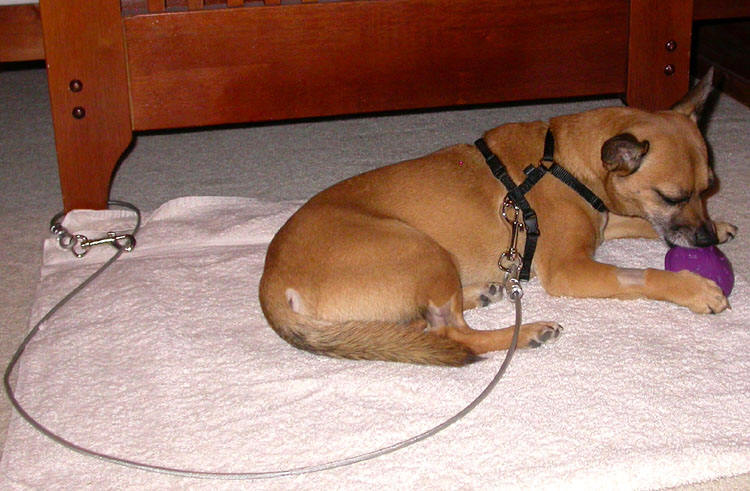
You can anchor a dog with a tether safely to an anchor (eye hook) in the wall (securely installed in a stud) or to a secure stationary object like a non-movable piece of furniture or do a reverse doorknob tether. A reverse doorknob tether (tm) — I totally just made that term up! — is when you put the leash on the opposite side of the door, on the knob, and shut the door on the leash so that it's completely secure. 

The tether is a great Success Station tool if you don't want your dog behind a physical barrier or out of the room (or he isn't good in those situations), but still safely secured so as not to be able to get up, move around and/or get to the baby. (Note: This is best when used only with non-mobile babies! Moving babies could easily approach a dog tethered and that's not safe, so other Success Stations are recommended for mobile babies, toddlers and kids.)  

CRATE STATION
My personal favorite Success Station is the crate. This is a great tool because it's totally secure and dog is completely out of the way and totally enclosed in a safe spot. This is also great for dogs that may be in the stage where they are still really unsure about the baby and you aren't certain of her feelings about this new little person, so they may feel better being in an entirely different room alone in a crate.

A crate Success Station is also perfect to use when you are very confident in how your dog handles being crated while you're home. If your dog is really crate-savvy and comfortable, this option is fantastic. If she's not, look at my troubleshooting section below.

GATE STATION (OR X-PEN)
Gates (or x-pens) are a great option as they help set boundaries for both dogs and children. They can also be located in various locations in your home and you can section off space that is large enough that Fido is comfortable and can have a nice space of his own away from baby. 

Be sure to get a secure gate and one that is tall enough for your dog. Also, be sure you know whether or not your dog will jump a gate or knock one over. If she does jump gates or knock them over I suggest maybe utilizing a different Success Station tool and do more training — you know in between all those baby feedings! — which is covered in my troubleshooting section below.

WHEN WOULD I USE A SUCCESS STATION?
There are many times when a Success Station would benefit you and your dog. Here are a few examples that are very common:

baby feeding time 
tummy-time on the floor
toys & fun for babies on the floor
when baby starts to roll over &/or crawl
toddler(s) playing & dog needs a safe place
kids running in & out of the home
kids having kids over to play (read: chaos!)
you have to work from home & need alone time
during dinner parties
holidays (read: lots of family & guests)
entertaining at your home (guests moving about your home)

WHY WOULD I NEED TO PUT FLUFFY AWAY?!
You may be asking – “Why can’t Fluffy stay out with me and baby? I want them to learn to live together!” This is a very common thought process for parents. They want their dog and child to learn to cohabitate and live around one another, to bond and build a relationship. However, the key to a fruitful relationship between Fluffy and baby is setting her up to learn to cohabitate peacefully and safely with baby. Remember: babies are only babies for a short time. This means that there is a lot of time for your child to learn and grow with Fluffy. 

In those beginning months, usually first few years, it’s most important that we simply teach Fluffy that having a child around means good things and no one will allow anything unsafe to happen.  Unsafe for dogs could mean a child: grabbing an ear, crawling quickly across the room, reaching for Fluffy’s toys, making loud baby sounds and many other things a child does that may be uncomfortable for Fluffy.

If Fluffy learns that a child equals loud sounds, unpredictable movements and grabbing, she may just decide children are no fun to be around at all.  So, it’s safest to teach her that in those beginning years we will keep her safe and offer good things while that unpredictable child is living in the same home. This will ensure that Fluffy builds good associations early and begins to look forward to being around your child because she knows you will not let anything uncomfortable happen and you’ll provide wonderful things when your child is around! Win!

HOW DO I SET UP A SUCCESSFUL SUCCESS STATION?
Your dog's Success Station should be very comfy and inviting. I suggest having a comfy bed or blanket for Fido in the Success Station area. Also, provide safe Success Station Goodies for him (see list of goodies to use below) while in there. Providing rewarding things ensures he will make positive associations with the Success Station.

I also highly recommend adding a Pet Acoustics cube near or in the area of the Success Station. This is a 2" x 2" x 2" cube that is a little speaker and emits calming tunes designed just for dogs. It comes with a little strap (like those cell phone straps) and you can hang it on a wall. It goes almost anywhere it's so small and portable! I love mine! 

Get Fluffy and take her to the Success Station*. Attach the tether to her collar, or put her into a crate or behind the gate. Give her a pre-stuffed, frozen Kong once she’s in the station. (For Kong Recipe ideas click here to download my recipes handout.) I also suggest you take time to get at least 3-6 Kongs, pre-stuff them and have them in the freezer and ready to serve as needed! If you need to use something other than a Kong you can use a mixture of several different goodies to give Fluffy while in there. 

Other SUCCESS STATION GOODIES instead of a Kong
Provide a bully stick for Fido to chew on (braided ones last longer)
Sprinkle Fluffy's kibble in a Snuffle Mat 
Deer/Elk/Moose antlers are good chews
Stuff a water buffalo horn with food; Fido can chew the empty horn too!
Fill a few interactive food puzzles for Fluffy to work on (more on my Pinterest board)
Give Fido a marrow bone (these can be raw/frozen or dry flavored)

It's really important that you provide some type of goodie while Fido is in the Success Station so he will build up good associations with being alone while you are with baby. He will start to think — oooh when mom feeds that little squeaky baby I get to be safe in my own little place & I get yummy things! That little squeaky thing can't be all that bad!  It’s even better if the only time he does get a goodie is when he is in the station.


HOW LONG SHOULD FLUFFY BE IN THE SUCCESS STATION?
This may vary depending on what’s going on. It’s great to do all the things laid out here so that whether Fluffy is in the station for 15 minutes or a couple of hours, she’s totally relaxed and fine with either.  Ideally, Fluffy should be ok in the station for whatever amount of time you need her to be in there.

*TROUBLESHOOTING
Is your dog not comfortable in a success station? Won't sit still? Whines? Paces? Barks? Stresses out when left alone when you’re in the other room? If your dog isn't good when alone, separated from you when you’re home, you'll need to do some training. This would ideally be before your baby comes but that isn't always the case. You can still do this slowly and successfully without having to spend a lot of time training.  The key is consistency and dedication. 

I also wrote a few blog post that may be of benefit as well, the first one is called “The most important thing to teach Fido” . Also another great one revolves around crates and their use, tips and more, titled “Crate Training Truths & Tips.”

You can do this, even with a busy and demanding lifestyle! So, start setting your dog up in Success Stations now, regardless if you are pregnant or already have a child …
  • Feed all meals in the area that will be used as a Success Station. No food or meals should be fed outside of this area for the next 30 days, only inside the crate, behind a gate or in an x-pen. This will help Fluffy think all the great things happen when inside the Success Station, hence she will want to be in there more often!
  • Put Fido in the Success Station for short periods of time and gradually increase the time he is in there. Be sure to put several goodies in there and make it as fabulous as possible.
  • Make all times Fluffy isn't in the room with you or is in any way separated from you a more desirable experience than being with you. This means when she's with you don't make it as fun as being without you. (Note: This is temporary until she finds being alone just as good as being with you.)
  • While working on Fido getting used to being in a crate, behind a gate or in an x-pen you can utilize the tether option for a Success Station. This is one that is good to use as the dog can be in the same room without being in or behind a barrier. Still provide all the same Success Station Goodies while Fido is tethered, listed above in the Success Station Goodies list. If baby is mobile you’ll also need to use an x-pen to put around Fido so dog cannot reach baby.
IN CONCLUSION
Success Stations are designed to help dog and baby cohabitate peacefully while parents can have peace of mind. There is a lot of info in this article, however, I do highly recommend you find a licensed Family Paws Parent Educator near you to come in and help your family draw up a plan to suit your needs best. If there isn’t an educator located near you there are several who do consults via Skype, FaceTime, or Zoom.  There is also a hotline that is answered all the time, free of charge (877) 247-3407. Family Paws Educators receive very specialized training (outside of normal dog training education) to specifically help families that are preparing for a baby, have a baby (or babies!) and toddlers.
------------------
Stacy Greer, CPDT-KA,
& Private Trainer with The Family Dog™
Sunshine Dog Training & Behavior
-------------------
servicing the Dallas/Ft Worth, Texas, USA metroplex
Copyright© 2018. All rights reserved.